Showing posts with label zen. Show all posts
Showing posts with label zen. Show all posts
Friday, February 27, 2015
"Long Quiet Highway"
There is a book from the early '90s I recently re-read, called: Long Quiet Highway by American author Natalie Goldberg. It is a autobiographical memoir of a writer who is immersing herself in Zen study while maintaining a career as an author and writing instructor. In the book, she reflects upon many aspects of Japanese Buddhism, including, in one passage, what it is that makes a good teacher. The fact that Goldberg is referring to Zen isn't necessarily the point. The skills and ideals are transferable to instructors of any kind.
"That is the work of a teacher, not to get caught in the likes and dislikes of a student, but to come forth always with the deepest teachings. Often the student does not like this, thinks the teacher is mean, unfeeling, but a good teacher knows that if he or she plants a real seed, someday, maybe years later, even in the most ignorant of students the seed may sprout. So the teacher's job is to close the gap between the student's ignorance and the teachings, but often the student does not understand any of this. That is why the student is the student. The teacher understands this. That is why the teacher can have abundant patience."
In the next paragraph the author discusses being a student, and what pushes us to want to expand our minds.
"But if the student doesn't know about the gap, how can she learn? There is something in us, an urgency to meet the teachings on the other side, that gnaws at our ignorance, that desires to meet our own true face, however lazy and comfort-loving we may seem to be. This something was working in me, albeit slowly, and often underground."
As a student of martial arts, I understand this. As a student of life, I also understand this. That is why finding the right teacher is so crucial, no matter what it is you wish to learn. And the responsibility of being a teacher is maybe even more immense. One has to be selfless, patient, and look at everything as a whole. After all, a teacher is really a student as well, as in the end, teaching and learning are one in the same.

Wednesday, January 7, 2015
Becoming Immune
In the realm of frenetic commercialism,
those who wish to find a quiet mind must work to develop a sort of
“materialistic immunity.” Just as the body can become immune to
certain diseases, so, too, can the mind subdue the unwanted “noise” of the world.
It is hard enough, I've discovered, to
find moments of peace without countless billboards pouring crap into
my conscious and subconscious mind. Life, it seems, is challenging on
its own, without omnipresent television screens with ego-filled
actors telling me what I “need,” and how to be happy. And when I
walk down a city street it feels akin to running a gauntlet of
materialism, and I know it impacts us all deeper than we think on the
surface. After all, that's the point of advertising, isn't it?
But peace can still be found. I try to
become consciously aware of my surroundings, and take my power back
by holding an internal place of focus amid the chaos.
The martial arts world, an argument
could be made, has become increasingly commercial in recent years as
well. Some dojos want to sell you what they have to offer, and
many teachers and students flaunt their knowledge as if advertising
their self-importance, unaware of the impact it may have on other
students with whom they train. While most instructors and students I
have met have been humble and approachable, there is always that one
guy or girl who fails to check their ego at the door.
Again, we need to focus on ourselves.
Martial artists train daily to cut out distractions, to breath, and
to redirect the energy of an attacker. In this case, the attacker may
be ego, materialism, or just unwanted attitudes of negativity. I just
try to redirect the unwanted energy. I try to become immune to
negative surroundings, and hopefully add a bit of positivity in the
process.
It is my way of trying to find a quiet
mind in a world that often seems out to confuse and distort what life
is all about.
Sunday, January 26, 2014
A Return...
I gave up on meditation about two years ago. Things in my life had drastically changed, and as a result, my focus on many things in life began to diminish. Also, a major factor, was that my time alone decreased significantly.
But recently, the art of sitting in silent contemplation has returned to my life.
It wasn't deliberate. I wasn't searching out solace or a way to regain my mental focus. And I'm not sure this will be the outcome, anyway, to tell you the truth.
Really, what happened was that I was reunited with a group of friends, who meet each week, and discuss books and spiritual ideas over coffee and tea. And they meditate. Twenty minutes at the beginning of each meeting.
Returning to meditation was daunting. At least at first. It had been a long time--my mind raced and I felt trapped. The clock ticked and my breathing was all over the place. But I settled in soon enough, and ended up having a pretty positive experience. Since then I have gone back four or five times, and manage now to find my zone pretty quickly.
But don't get me wrong, this isn't at the level of "no mind," transcendental type meditation. I'm still a hack, really, just trying to calm my mind here and there. No chakras are being opened, believe me, I'm just trying to sit and be relaxed for a twenty minute space of time.
And this approach has made it easier for me this time around. I am putting less pressure on myself to achieve results. In fact, I'm just happy to sit, my mind swirling, with the odd moment of peace tucked in for good measure--often accidentally.
But it's good to be back, for sure, and we'll worry about those chakras another day.
Tuesday, January 8, 2013
the broken buddha....
Years ago, a friend of mine was going through hard times. We were young. He left the city where we lived and went to stay with his folks for a year before he moved away once again for some further education.
He lived in a basement. He wrote a book of poetry. He met me sometimes for a chat or to throw around the football.
Pain is a strange thing, as most of us know. Enlightenment can truly arise from its depths. Don't get me wrong, any of us would trade away the anguish in a second for some calm and joy. And his trials would pass, in time.
Anyway, one of my best glimpses of Zen came from those days--in the shadowy basement of a suburban bungalow--in a city just like any other. I guess my friend had ordered Chinese food, not wanting to cook one evening, and the food had arrived with one of those cheap scroll calenders that most customers throw out. You know, the ones that say it's the year of the tiger or whatever and then have a calendar beneath this info with a giant business card ad... i.e. the true motivation for giving the calendar in the first place. (Phew... I'm out of breath now). Well, this calendar hung on the wall for the whole year in my friends room.
Backwards.
Yup. The words and images faced the wall. And in tiny writing, barely discernible on the otherwise blank back of the scroll, was a barely legible sentence. It read: "Time does not exist."
And to this day I am sure that my friend was right.
He lived in a basement. He wrote a book of poetry. He met me sometimes for a chat or to throw around the football.
Pain is a strange thing, as most of us know. Enlightenment can truly arise from its depths. Don't get me wrong, any of us would trade away the anguish in a second for some calm and joy. And his trials would pass, in time.
Anyway, one of my best glimpses of Zen came from those days--in the shadowy basement of a suburban bungalow--in a city just like any other. I guess my friend had ordered Chinese food, not wanting to cook one evening, and the food had arrived with one of those cheap scroll calenders that most customers throw out. You know, the ones that say it's the year of the tiger or whatever and then have a calendar beneath this info with a giant business card ad... i.e. the true motivation for giving the calendar in the first place. (Phew... I'm out of breath now). Well, this calendar hung on the wall for the whole year in my friends room.
Backwards.
Yup. The words and images faced the wall. And in tiny writing, barely discernible on the otherwise blank back of the scroll, was a barely legible sentence. It read: "Time does not exist."
And to this day I am sure that my friend was right.
Thursday, June 14, 2012
the Self
You will never master the Self, yet it should be your life's work to try.
Perhaps mastery just happens in specific moments; perhaps the journey, is, in fact, more important than the destination. The physical world is too malleable and uncertain to contain Heaven or Nirvana. What is left is the Way--the Tao--the path back to one's Self.
And the Self is a sword blade that can cut all things around it, but never cut itself. We must try to keep that blade as sharp as possible. Our Minds need training and discipline.
"Nirvana is reached by that man who wisely, heroically, trains himself," suggests the Dhammapada texts.
Mastery, to the followers of Buddha, is to be found in the transcendence of the world's sorrows. Buddha sat under a tree until he mastered Himself; and His enlightenment was lasting. (So on paper, my argument is incorrect).
But most of us are not ascended beings.... at least yet.
So we train. And train some more. We seek after glimpses of Nirvana rather than total enlightenment. For this is our nature... we are seekers. If we found the entire truth, the game would be up. Right?
And maybe then, eventually:
"With the dust of impurities blown off, and free from sinful passions, (we) will come unto the glorious land of the great." (Dhammapada)
Perhaps mastery just happens in specific moments; perhaps the journey, is, in fact, more important than the destination. The physical world is too malleable and uncertain to contain Heaven or Nirvana. What is left is the Way--the Tao--the path back to one's Self.
And the Self is a sword blade that can cut all things around it, but never cut itself. We must try to keep that blade as sharp as possible. Our Minds need training and discipline.
"Nirvana is reached by that man who wisely, heroically, trains himself," suggests the Dhammapada texts.
Mastery, to the followers of Buddha, is to be found in the transcendence of the world's sorrows. Buddha sat under a tree until he mastered Himself; and His enlightenment was lasting. (So on paper, my argument is incorrect).
But most of us are not ascended beings.... at least yet.
So we train. And train some more. We seek after glimpses of Nirvana rather than total enlightenment. For this is our nature... we are seekers. If we found the entire truth, the game would be up. Right?
And maybe then, eventually:
"With the dust of impurities blown off, and free from sinful passions, (we) will come unto the glorious land of the great." (Dhammapada)
Wednesday, April 25, 2012
brains...
I woke my son up for junior kindergarten today, and while normally he pops right out of bed, he took a few minutes and then said:
"Dad, sometimes I just need to warm my brain up first."
"Dad, sometimes I just need to warm my brain up first."
Thursday, November 10, 2011
gallery images....


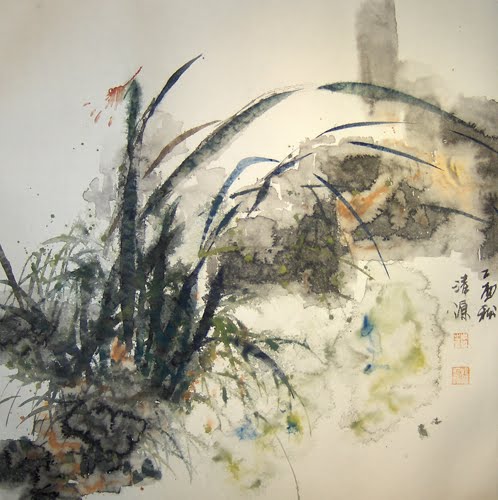

The artists are, in order, Bai Xiojun, Quan Handong, Zhou Xiao, and Luo Yanan. The gallery is located in Edgarton, MA, in the US.
Thursday, November 3, 2011
the zen of the west....
 The modern merging of eastern and western thought is not actually new.
Many ancient texts and thinkers of the West incorporated a less linear approach to the Natural world, the cosmos, and humankind, including the Gnostic Christians who were wiped out en mass in the early days of the Universal Church. Later, the emergence of Hermetic thought echoed more abstract ideals (claiming lineage from Egypt), and thinkers such as Giordano Bruno were martyred for philosophies that may have rivaled the innovation of Galileo. (Bruno claimed the sun was, in fact, a star, and was one of an infinite number in the Universe).
While I'm not suggesting these thinkers had personal ties to the East, I am asserting that there was more simultaneous and similar thought processes apparent in the West and East throughout history. (Even alchemy can be linked, albeit different in expression, to both China and Europe).
Here's some quotes from some of the more influential and occulted texts of the past centuries in Europe:
"In a sense, the Cosmos is changeless, because its motions are determined by unalterable laws.... Its parts manifest, disappear and are created anew... Even the present does not last, so how can it be said to exist...?" -- the Hermetica
"The All creates in its infinite Mind countless universes... The infinite Mind of The All is the womb of the universe." --the Kybalion
What happened, historically, is that much of the Western thought that did not toe the party line went underground or became protected by secrecy. A good example is alchemy, whereby under exoteric terms it was a science to do with transforming metals, esoterically it was a guideline to transform one's soul into purity. This, to me, is not unlike seeking enlightenment through contemplation and/or physical training.
So the merging of East and West is just like using both sides of the brain. Each contains knowledge of the other, yet expresses it in varied ways.
But the blending is far from a recent phenomenon.
Friday, October 14, 2011
returning....
 A Taoist concept I am trying to get my head around is the following: Returning is an essential element of the Way.
On the grand universal scale it makes sense, everything lives, dies, and returns to its source. But how does it apply on a personal level? Or, a martial level for that matter?
Maybe, it is merely karma. Everything we give out returns to us in the course of time, as a matter of karmic balance. In Buddhist theory, this does not just apply to the here and now, but applies to the evolutionary aspects of reincarnation as well. But the Tao is more abstract. Perhaps less specific in this regard.
Personal and emotional equilibrium is another possibility. We return to ourselves and our balanced emotional state after every encounter or event. In martial terms this would be exertion, followed by the restful (yet aware) state of being. It would be about constantly recalibrating one's Mind, per se, or even the physical body itself. (Realigning to nature itself?) This is a return to the "unchanging aspects" of oneself.
Lastly, it could all be about cycles--or circles--so prominent in eastern thought. We always return to the beginning of the circle. We evolve in cycles and return to beginner's mind in all we do. In jiu-jitsu, the circle is paramount, and we always complete the circle of a technique and return to the starting point.
And each morning we return to a new day, and study more and more about the nature of ourselves and all around us.
Thursday, July 21, 2011
American Buddhism--Part Three...

Gary Snyder.
Another Beat/San Francisco Renaissance writer who spent his time divided between the U.S. and Japan. In Jack Kerouac's book, Dharma Bums, he is the poet Japhy Ryder who spurs the author on towards Zen meditation and ideology. His poetry is naturalistic and infused with Japanese sensibility. And oh yeah, he has won a Pulitzer Prize for his efforts. Synder has also translated Chinese and Japanese texts into English.
"In the blue night
frost haze, the sky glows
with the moon
pine tree tops
bend snow-blue, fade
into sky, frost, starlight.
The creak of boots.
Rabbit tracks, deer tracks
what do we know." - G.S.
Synder's Zen influence on his contemporaries is undeniable. And his spiritual approach to life and literature opened many artistic avenues for his peers.
While living in Japan, Synder received the name Chofu (Listen to the Wind). And along with awards for Nature Writing, "Synder also has the distinction of being the first American to receive the Buddhism Transmission Award (from 1998) from the Japan-based Bukkyo Dendo Kyokai Foundation." -- wikipedia
Worth checking out, for sure.
Saturday, May 14, 2011
American Buddhism--Part One....

Western Buddhism is not Eastern Buddhism.
So explains Shunryu Suzuki in his book Zen Mind, Beginner's Mind.
He's not being critical so much as realistic. Culture and history influence things too much.
That said, I for one, appreciate the fusion of East meets West. It began in the 1800s with Asian immigration, and the literary efforts of the transcendentalist and theosophical movements (see naturalists Emerson, Thoreau, et al). Over many decades, the exploration of Eastern philosophy perhaps peaked during 1960s hippie culture and later New Age-ism. Along with increased immigration from Asia, and post WWII relations with Japan, today, Buddhism is one of the largest faiths in the U.S., comparable in numbers to Islam.
But, in my opinion, an influence largely overlooked in the emergence of Western Buddhism is the work of the post WWII Beat writers. These include the likes of Allen Ginsburg, Gary Snyder, and the lovable Jack Kerouac. The latter not only discussed Buddhism regularly in his pseudo-fiction tales of travel across America, but also created a form of hybrid Zen/American poetry. The Diamond Sutra was a major influence in the author's life.
Here's some ol' Jack, composed during a month-long, isolated stint as a mountaintop fire ranger:
"On foggy days the view from my toilet seat is like a Chinese Zen drawing.... I half expect to see two giggling old dharma bums, or one in rags, by the goat-horned stump, one with a broom, the other with a pen quill, writing poems about the Giggling Lings in the Fog--saying, 'Hanshan, what is the meaning of the void?' " -- Desolation Angels
And here he explains the need for poetic differences between the two continents:
"A 'Western Haiku' need not concern itself with the seventeen syllables since western languages cannot adapt themselves to the fluid syllabic Japanese." -- Book of Haikus
Later in life, Kerouac reverted back to his Roman Catholic roots, but his mark on American culture, in terms of East meets West, is undeniable.
"The second teaching from the golden eternity is that there never was a first teaching from the golden eternity. So be sure." --Kerouac
Tuesday, April 19, 2011
Lesson from the desert....

Several years ago, my wife and I were driving through the desert in Arizona, enjoying the vastness of the landscape. There were no houses, save the odd Navajo dwelling every few miles or so, and any cell phone signals were nonexistent.
Yet, at one point, after an hour of driving, we came upon several sheep trying to cross a ditch to get to the road. There were no fences anywhere to be seen, or people, just a ragged looking border collie nudging the animals back from the road.
Whose were they? Why weren't they fenced in?
The memory reminded me of saying I came across in a book by the Zen Buddhist Shunryu Suzuki: To give a sheep or cow a large, spacious meadow is the way to control him.
Hmm. I love thinking about this. And although I am sure it has martial parallels or daily life application, I don't feel I need to delve into these areas. I just enjoy thinking about these sheep and how by giving them absolute freedom they were under more control than any barrier could achieve.
Sunday, March 20, 2011
the Stubborn Warrior

Before Yoda there was author Carlos Castaneda and his Yaqui sage Don Juan Matus.
In the books, the old shaman is constantly trying to teach the younger man to expand his mind and break away from the social conditioning of his past in order to gain true insight into the world.
But the student is stubborn, and keeps finding excuses to hinder his own progress. He likens himself, and his resulting sorrow, to that of a leaf being blown by the wind.
And so he is chastised.
"The hardest thing in the world is to assume the mood of a warrior," (Don Juan) said. "It is of no use to be sad and complain and feel justified in doing so, believing that someone is always doing something to us. Nobody is doing anything to anybody, much less a warrior.
"You are here, with me, because you want to be here. You should have assumed full responsibility by now, so the idea that you are at the mercy of the wind should be inadmissible."
Castaneda gained a big New Age following with these stories that continues today. I think part of the reason for the popularity is the author's subtle parallels of wisdom between the indigenous cultures of both east and west (it provides an almost zen-like tradition based in the Arizona desert). For me, the whole student and teacher theme, explored in many a legend and parable, is more than just a literal description of knowledge being passed between the old and the young. To me, it reflects the concept of the Higher Self communicating with the intellectual self.
Saturday, March 12, 2011
Dragon Slayers

"There is no greater curse than discontent."
Once again, the words of Lao Tsu as written in the Tao Te Ching.
I bet any one of us can relate to this idea. It emerges during the periodic frustration due to our striving for results.
Such discontent is entwined with our ego's need to recognize it's own achievement. I am reminded of mythologist Joseph Campbell, who equated the many tales of slaying dragons as an act of overcoming our own ego-self. However, we need not slay or suppress such a beast, rather just acknowledge that it exists and is merely an aspect of ourselves that need not oppress us or be feared.
I don't view defeating one's ego as eliminating individual identity--merging into a mass military mindset--but instead, permitting a balance to exist within one's mind while on the path of bettering oneself (as a martial artist or a person). In other words, understanding that some struggle is needed in order to grow, but not becoming a slave to, or rushing towards any specifically desired outcome.For while the Tao of Heaven does not strive, Lao Tsu insists that it still overcomes.
Take this concept back to practical martial application. To strive intellectually for results usually leads to sub-par form, and therefore frustration. When effortless reaction is used, based in repetitive practice, a harmonious feeling is achieved.
A proper balance.
And therein can be found the skills to defeat the dragon.
Saturday, February 12, 2011
Words

The Zen tradition of haiku--although I don't study it in depth--is worth some serious thought.
Why? Because it is probably the strongest example of the ancient Japanese obsession with simplicity, effectiveness, and critical observation. It is an exercise of clear mind and articulate execution. Really, it is a reflection of the culture's views on combat, as well, where a warrior seeks to attain the deepest energy and control with the least amount of external effort.
In fact, many samurai were obsessed with this art form, and myth suggests that capturing the perfect words before a battle-induced death was an example of true virtue among the warrior class.
Here are the words of Basho, a samurai's son:
Summer grasses
all that remains
of soldiers dreams.
This work is not only a lesson in the philosophy of war, but life, itself. All in seven words (translated, of course).
It is the same concept of spending one's life trying to make the perfect throw; the perfect strike; or the perfect ukemi. It is akin to summing up a lifetime of training with one perfect thrust of the katana.
All so simplistic but never easy to attain.
Friday, January 28, 2011
Qi: Part One
 (the energy of uniting opposites?)
It's my belief that everyone who trains eventually searches for the verification of qi energy.
It may be conscious or not; it may not be why one begins their journey--but it is always encountered along the way.
And the thought never really goes away. Even if you think it has.
Perhaps the reason for this is that anyone who has spent any significant amount of time training has experienced the near-electric feeling of energy being properly focused and used to its full potential (sometimes by ourselves, often at the hand of another). As a friend who studied aikido once told me about his instructor: "I don't know what it is, but for some reason every time my Sensei throws me it hurts like Hell because it's so powerful. It's like getting hit by a truck. But then, for some reason I can't wait to get thrown and feel the energy again."
His teacher was barely five-feet-tall and my friend is about six feet.
And we've all either felt this ourselves or heard stories like it.
Now, Qi shouldn't necessarily be confused with fire shooting from one's fingertips. It is subtle. It's like looking for something that is so hard to find, only to realize that it IS US. We are the eye that, in Zen fashion, can look directly at anything in the world except itself.
Science, especially when it comes to quantum mechanics, could likely make a strong case for qi being a simple alignment of magnetic/electric body systems with non-local results. After all, the body, as with all matter, can theoretically be broken down into more of a frequency than a tangible solid, by these same scientists (and ancient mystics). Or a psychologist may assert that it's all the result of positive thinking and visualization. (This is the argument the skeptics prefer, that it's all in your head--and they wouldn't be entirely wrong. The world exists alone in one's consciousness, really, and the outer is a symptom of the inner.)
Any reasonable student of meditation will tell you that one goal of their art includes mentally breaking down the barriers between the external and the internal. In aikido circles--pun intended--this is the concept of tori and uke becoming as one. When this unity is achieved, the relationship is altered, and the separation of the tori's mind (intent) and the action of the uke is eliminated. And when two opposite forces unite.... well.... it's electric.
In this process, imagination IS the method of accessing qi. And when your mind buys into it, the body--a water-based conductor--aligns with the energetic signals of the brain.
And the Qi was there all along.
Thursday, December 23, 2010
the central mountain

--Secrets of the Samurai, Ratti/Westbrook

"Black Elk said, 'At one moment in my dream I saw myself in the central mountain of the world, and the central mountain of the world was Harney Peak in South Dakota.' And then he added immediately, 'But the central mountain is everywhere.' " -- Joseph Campbell, mythologist
Thursday, December 9, 2010
The Wheel -- Part Two

While still thinking about the cycles of learning and understanding, I came upon a good Zen saying while flipping through the Tao of Physics, a classic book by Fritjof Capra that has been around for a few decades now. To me, the saying has its parallel in the stages of technical development.
Before you study Zen, mountains are mountains and rivers are rivers; while you are studying Zen, mountains are no longer mountains and rivers are no longer rivers; but once you have had enlightenment, mountains are once again mountains and rivers again rivers.
Basically, we are all using the intellect in order to arrive at a point where it is no longer used or needed. All of our technical knowledge can be broken down this way: we see a technique being done by others, easily and effectively, all as one movement; while learning, we break the movements down into various parts such as, angles, speed, force; and then, after much practice, we come to a state of mind where there is no longer thought involved in execution.
Once again, rivers are rivers.
Monday, July 19, 2010
A Soldier's Journey

Claude Anshin Thomas was a young hapikdo and zen student when he was sent to fight for his country in the jungles of Vietnam.
A few years ago I stumbled upon his book, At Hell's Gate: A Soldier's Journey from War to Peace, and I still cannot get it out of my head. To sum it up, the work is a compilation of Thomas' memoirs of the pain of battle, the trauma of returning home, and his difficult search for peace in post-Vietnam America.
Explains Zen at Warrior author Brian Victoria:
"Thomas was deeply moved when (Zen master) Thich Nhat Hanh (said): 'You veterans are the light at the tip of the candle. You burn hot and bright. You understand deeply the true nature of suffering'. He also informed them that the only way to heal, to transform their suffering, was to stand face-to-face with suffering, to realise the intimate details of suffering and how their life in the present is affected by it. By doing this, the Vietnamese master explained, the veterans had the potential to become a powerful force for healing in the world." -- dharmalife.com
Since 1994, Thomas has walked over 19,000 miles as part of "peace pilgramages" and is the founder of the Web site zaltho.org, "A spiritually based foundation committed to ending violence by encouraging and establishing socially engaged projects in schools, communities, organizations, and families, with an emphasis on the most important ingredient, the individual." -- zaltho.org
Anyway, the book just sticks with you in a haunting yet positive way. It gives real insight into the hardships of a modern-era warrior monk. A monk who realizes the value of peace over violence.
Anyway, the book just sticks with you in a haunting yet positive way. It gives real insight into the hardships of a modern-era warrior monk. A monk who realizes the value of peace over violence.
Wednesday, July 14, 2010
Moon in Water

Technique must be unconcious.
The following quote from an ancient writer (as borrowed by Daisetz Suzuki in Zen and Japanese Culture) explains a teaching used in an old school for swordsmen.
"...The main idea is to grasp the way the moon reflects itself whenever there is a body of water... Again, it is like one moon reflecting itself in hundreds of streams: (However) the moonlight is not divided into so many shadows, but the water is there to reflect them; the moonlight remains ever the same even when there are no waters to hold its reflections."
The Zen goal of swordsmanship was to not to become entangled in the illusory conflict between two forces. Rather, it was the playing out of a unified force of nature. There existed no difference between the two combatants, their swords, or the earth itself. No warrior won and neither could lose. They became as the moon, not its reflections. The reflections were merely the technical aspects: the steps, the blocks, and strikes.
Reflects Suzuki:
"When this is not realized.... instead of flowing, as (Takuan) says, from one object to another, the mind halts and reflects on what it is going to do..... (these thoughts) must be given up so that they will not interfere with the fluidity of mentation and the lightning rapidity of action."
*Takuan Sōhō (1573–1645) was a major figure in the Rinzai school of Zen Buddhism. -- wiki
Subscribe to:
Posts (Atom)