Well, training has wrapped up until the new year.
Sometimes a break is good... to heal injuries, ponder one's progress, and relax a bit with family. I'm looking forward to these things, as well as coming back refreshed and with a clear mind. It represents yet another cycle--or circle--of life and training.
Time off, it seems, can actually make one better at what one does. It's strange but true.
So Happy Holidays everyone, and I'll try to write a bit more during the break!
Friday, December 23, 2011

Sunday, December 11, 2011
being low...
The Valley.
In Taoist terms, being like a valley is to place yourself humbly beneath others around you. By doing so, even the persona of water--arguably the most powerful and adaptable force on earth--will be directed to your feet by the passive use of gravity. It is a great metaphor in terms of slaying the ego.
In terms of physical application, the valley is symbolic of letting one's opponent come to you. Stillness overcoming force. Gravity, as all martial artists realize, is a powerful tool, and is the root of many a valuable technique.
In fact, it reminds me of my sensei who I've often heard teaching students, when sparring with a taller opponent, to bend down even farther, and slowly lure the opponent into lowering him/herself to reach you. Then when you feel ready, the trick is to pop back up and execute your attack.
This is from the same teacher who insists, somewhat in jest, that the most balanced position the human being can find themselves in is lying flat on his/her back.
Likely some brazilian jiu-jitsu guys might appreciate this comment.
In Taoist terms, being like a valley is to place yourself humbly beneath others around you. By doing so, even the persona of water--arguably the most powerful and adaptable force on earth--will be directed to your feet by the passive use of gravity. It is a great metaphor in terms of slaying the ego.
In terms of physical application, the valley is symbolic of letting one's opponent come to you. Stillness overcoming force. Gravity, as all martial artists realize, is a powerful tool, and is the root of many a valuable technique.
In fact, it reminds me of my sensei who I've often heard teaching students, when sparring with a taller opponent, to bend down even farther, and slowly lure the opponent into lowering him/herself to reach you. Then when you feel ready, the trick is to pop back up and execute your attack.
This is from the same teacher who insists, somewhat in jest, that the most balanced position the human being can find themselves in is lying flat on his/her back.
Likely some brazilian jiu-jitsu guys might appreciate this comment.
Monday, November 28, 2011
getting hit on the way in....
"I never told you that you wouldn't get hit."
This was a passing comment from a sensei at a recent seminar I attended at another dojo. I knew what he said was valid, and have thought about it before, but it resonated with me this time more than ever. In our style of jiu-jitsu we are taught to immediately move in towards our opponent, so the risk of getting hit--even while blocking--is definitely there.
"I rather take 40 per cent going in and then give 100," explained the instructor. "And the day you aren't afraid is the day you really get hurt."
During the two-hour session we learned and practiced many solid techniques, from joint locks to punch counters. But it was the words such as those above that made the bigger impact on me.
Another comment had to do with the practical nature of low kicks. "Up high is fine for tournaments and practice, but on the street it's foolish." This, too, I've heard before (even in the writings of Bruce Lee), however, there are many respectable individuals who disagree that I've met as well.
Regardless, sometimes it's the little comments that make one really think.
This was a passing comment from a sensei at a recent seminar I attended at another dojo. I knew what he said was valid, and have thought about it before, but it resonated with me this time more than ever. In our style of jiu-jitsu we are taught to immediately move in towards our opponent, so the risk of getting hit--even while blocking--is definitely there.
"I rather take 40 per cent going in and then give 100," explained the instructor. "And the day you aren't afraid is the day you really get hurt."
During the two-hour session we learned and practiced many solid techniques, from joint locks to punch counters. But it was the words such as those above that made the bigger impact on me.
Another comment had to do with the practical nature of low kicks. "Up high is fine for tournaments and practice, but on the street it's foolish." This, too, I've heard before (even in the writings of Bruce Lee), however, there are many respectable individuals who disagree that I've met as well.
Regardless, sometimes it's the little comments that make one really think.
Thursday, November 24, 2011
Judo joint locks...

Not being a sport judo historian per se, I found this quote intriguing:
"Attacks against all joints were permitted in early judo contests...(but) have gradually been restricted in tournaments to elbows only. In 1899, locks of the fingers, toes, wrists, and ankles were banned (knee entanglement or twisting knee locks were banned in 1916). Joint lock attacks were limited in contests to the elbow in 1925..."
-- Judo Unleashed, Neil Ohlenkamp
Elbow locks, the book's author says, allows more opportunity to "tap before injury can occur." It also says that further locks are explored in judo kata. I can't verify this, as I am not a full-fledged judoka, but I am sure some of my readers can definitely speak to this.
I just like the notion of how people today debate the merits of point sparring, grappling, MMA etc., when judo seems to have been analyzing safety vs. realism for so long now. Although I understand certain other techniques have been banned in judo over the years, I'd be very interested in discovering what more recent adjustments have been made in sport judo, and the pros and cons of such decisions.
Thursday, November 17, 2011
final report...???
Well, I finally gave my leg the full test.
And, touch wood, it held up wonderfully.
Don't get me wrong, I still fear a recurrence of the muscle pull (tear?), but I did some light sparring exercises for the first time since the injury occurred and walked away intact. For those who recall, it was such exercises that were involved in the initial injury. I also used my full weight for other techniques and even kicked the heavy bag full tilt again (this felt good--a lot of pent up tension).
But here's the catch. I took my four-year-old ice skating and felt a twinge by merely doing slow laps of the rink with him. This reinforces caution, of course, but hey, at least the dojo time went well.
So hopefully the injury reports are finished for now and some serious (and not so serious) training can get back under way.
And, touch wood, it held up wonderfully.
Don't get me wrong, I still fear a recurrence of the muscle pull (tear?), but I did some light sparring exercises for the first time since the injury occurred and walked away intact. For those who recall, it was such exercises that were involved in the initial injury. I also used my full weight for other techniques and even kicked the heavy bag full tilt again (this felt good--a lot of pent up tension).
But here's the catch. I took my four-year-old ice skating and felt a twinge by merely doing slow laps of the rink with him. This reinforces caution, of course, but hey, at least the dojo time went well.
So hopefully the injury reports are finished for now and some serious (and not so serious) training can get back under way.
Thursday, November 10, 2011
gallery images....


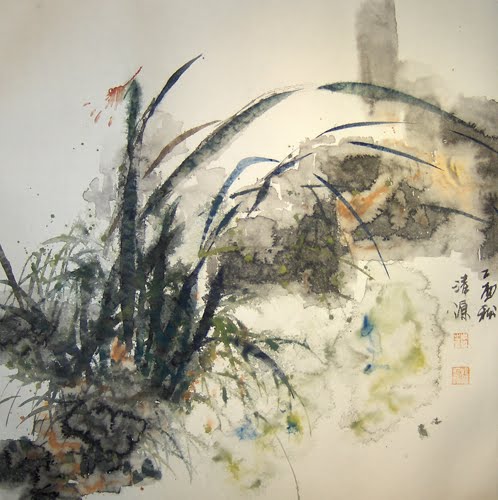

The artists are, in order, Bai Xiojun, Quan Handong, Zhou Xiao, and Luo Yanan. The gallery is located in Edgarton, MA, in the US.
Monday, November 7, 2011
reality....
This story has been in my head for awhile.
A friend, and competent practitioner of the martial arts, was walking down a city street at night with a friend when he was attacked. Two men jumped them and put the one friend into the hospital with pretty bad injuries. My friend was beaten, too, but not nearly as severely.
Since that night, about three years ago, my friend has completely stopped training as he felt his skills didn't 'kick in' when needed. He has become disillusioned and cynical when it comes to the art form he used to love.
Now, I don't want to write a post about how he should resume training and how it could have happened to anybody etc. Nor do I want to comment on his teacher or his style--as I don't think that was the issue anyway.
Instead, I just think about why he feels the way he does and how I would feel
if that happened to me. Are we allowed to 'lose'? Are we allowed to have 'doubts' and weaknesses'?
It reminds me of how real violence can be, and how instincts differ from person to person.
I know there is a gap in my friend's life to this day.
A friend, and competent practitioner of the martial arts, was walking down a city street at night with a friend when he was attacked. Two men jumped them and put the one friend into the hospital with pretty bad injuries. My friend was beaten, too, but not nearly as severely.
Since that night, about three years ago, my friend has completely stopped training as he felt his skills didn't 'kick in' when needed. He has become disillusioned and cynical when it comes to the art form he used to love.
Now, I don't want to write a post about how he should resume training and how it could have happened to anybody etc. Nor do I want to comment on his teacher or his style--as I don't think that was the issue anyway.
Instead, I just think about why he feels the way he does and how I would feel
if that happened to me. Are we allowed to 'lose'? Are we allowed to have 'doubts' and weaknesses'?
It reminds me of how real violence can be, and how instincts differ from person to person.
I know there is a gap in my friend's life to this day.
Subscribe to:
Comments (Atom)